Summer 2017
Living from Depth
We flee from what we most need.
Featured Article • Living from Depth
Living from Depth
by James Flaherty
Reading Sherry Turkle’s essentially important book, Reclaiming Conversation: The Power of Talk in a Digital Age, I learned that merely having a cell phone on the table during a meeting or conversation lessens the concentration, the focus, the presence of everyone there—even if no one uses the phone. An everyday occurrence is someone speaking with great authority on a complex topic she or he hasn’t studied, but merely read something about just a few minutes ago. Probably most of us, a lot of the time, follow our associative mind that gets triggered to think about something by the preceding thought and then goes on and on with no through line of meaning or intention.
The list could go on: we interrupt people in the middle of what they’re saying, imagining we know what will happen next. We watch a movie while answering our e-mail and having a conversation with someone. We pick books or articles because of their short length, not by their rigor or ability to challenge us.
So often we fall into lives that preclude the possibility of depth—of profound, extended contact with someone else, the situation we’re in, or even with our own experience.
How about you?
Do you have your life arranged so you have recurring occasions for entering and exploring the depths?
What I’m saying here is well known. The world’s religions have days set aside for entering the depths through reflection, contemplation, remembering our place in the universe, but we can easily fill these times with household chores, errands, going through the motions of traditional rituals while our heart and mind are elsewhere.
When we neglect the depths we never get to find out who we are, because that takes quiet, solitary introspection over an extended period of time.
Missing regular encounters with depth, our lives lack meaning that we unsuccessfully try to substitute for with frantic activity and endless distraction.
Without depth we cannot meet the inevitable difficulties of our life—loss, brokenheartedness, disappointment, illness, death itself—with clarity and stability. Instead we attempt to cover them up, numb ourselves or cut off whole parts of ourselves so as not to feel them. We lose our humanity, become less alive.
We cannot be of much use to others unless we meet them from depth, where wisdom and compassion reside and spontaneous insight is sourced.
Attending to our development as people—as distinct from getting more skillful at a task or accumulating more success—requires that we regularly encounter and become familiar with depth. Being more developed means we can be more kind, patient, creative, and expressive of our unique gifts.
In our times of relentless, unpredictable, tumultuous change, living in and from depth brings us resilience and creative responsiveness instead of reactivity, cynicism and resignation.
Some people might see a downside to depth. They might say that living from there would take away the human touch, or spontaneity or humor or practicality or popularity. Like you, I can clearly see our Western cultures pulling for speed, the easily graspable idea or concept, and the immediate, strong, emotional reaction. But I would say that our major, pressing, immediate problems—the environment, economic inequity, social injustice, epidemic drug use and so on—come from our making decisions that lack depth: decisions that don’t consider the long-term, the consequence for people outside of our immediate circle of concern, or all the systemic factors implicit in them.
What do you make of this?
How important is depth for you?
Why is that?
I’m sure you know that living from depth or knowing ourselves as depth, if that formulation makes sense to you, is not so easy given all the ways our daily lives pull us into quick, superficial interactions. Besides that, entering the depths means that we are willing to encounter that which we have been ignoring or otherwise not attending to. Consequently, for quite a long time, visiting the depths means feeling body sensations that we don’t like, emotions we would prefer avoiding, memories of shame and regret, and the basic encounter with our mind—usually a neurotic and chaotic process.
So you see it’s up to you, once you know there is such a thing as depth and what it can make possible. Will you ford the rapids of mind and body to come to the warm, still, bottomless places of depth?
Certainly our coaching work originates there, and it’s intended to awaken our clients’ appreciation and access to depth.
How will you respond to all I’m saying?
The poems that follow, the practice of the quarter and the book review can all assist you as you explore and choose your path.
Take care of yourself.
Love,

Practice • Entering Greater Depth
Focus: Entering Greater Depth
Please do this practice for 35 to 45 days. The lead article is the background for understanding this practice.
Please stop twice per day and ask yourself the following questions. Please actively take up what you learn and shift your attention and actions accordingly.
During this period of time:

- What invitations, chances, opportunities were there for me to enter greater depth?
- How did I respond (if at all)?
- If I did respond, what shifted in my experience?
- What did I do to bring greater depth to whatever I was doing? Whatever conversation/relationship was there? To whatever I was reflecting on?
- How did I go about that and what were its effects?
- How will I take what I learned in this period of observation into the next period of time so that I have greater depth in my life?
Poetry & Reading
Poems of the Quarter
Dirge Without Music
Edna St. Vincent Millay
I am not resigned to the shutting away of loving hearts in the hard ground.
So it is, and so it will be, for so it has been, time out of mind:
Into the darkness they go, the wise and the lovely. Crowned
With lilies and with laurel they go; but I am not resigned.
Lovers and thinkers, into the earth with you.
Be one with the dull, the indiscriminate dust.
A fragment of what you felt, of what you knew,
A formula, a phrase remains,—but the best is lost.
The answers quick and keen, the honest look, the laughter, the love,—
They are gone. They are gone to feed the roses. Elegant and curled
Is the blossom. Fragrant is the blossom. I know. But I do not approve.
More precious was the light in your eyes than all the roses in the world.
Down, down, down into the darkness of the grave
Gently they go, the beautiful, the tender, the kind;
Quietly they go, the intelligent, the witty, the brave.
I know. But I do not approve. And I am not resigned.

Grace and the Great Turning
Joanna Macy
When you act on behalf
of something greater than yourself,
you begin
to feel it acting through you
with a power that is greater than your own.
This is grace.
Today, as we take risks
for the sake of something greater
than our separate, individual lives,
we are feeling graced
by other beings and by Earth itself.
Those with whom and on whose behalf we act
give us strength
and eloquence
and staying power
we didn’t know we had.
We just need to practice knowing that
and remembering that we are sustained
by each other
in the web of life.
Our true power comes as a gift, like grace,
because in truth it is sustained by others.
If we practice drawing on the wisdom
and beauty
and strengths
of our fellow humans
and our fellow species
we can go into any situation
and trust
that the courage and intelligence required
will be supplied.
Book of the Quarter
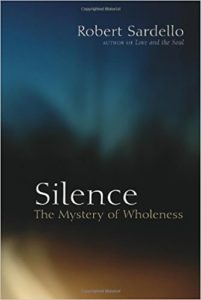
Silence: the Mystery of Wholeness
Robert Sardello
North Atlantic Books, 2008
Paperback: 152 pages
The dedicated, experienced, wise Robert Sardello wrote this profound book on a topic that is almost impossible to speak about: silence. He’s not talking about the absence of sound, but rather to something always present simultaneously in the background and also intimately connected to our direct experience. Silence, according to the author (and you can find out the truth of this by following the directions for practices in the book) stretches everywhere; consequently, when we encounter it we uncover our relationship with everyone/everything else. Like I said: a difficult topic to speak about.
The author’s point is not to be otherworldly or obtuse, but rather to reveal the hidden depth of every moment of existence. It’s best to read the book like an extended poem or detailed, pointing-out instructions that a meditation teacher might use to show us the nature of our own experience—the nature of being itself. Reading it with critical rationality won’t work because the topic eludes any categorization, cannot be compared to anything else, cannot be known by our usual methods.
Nonetheless, entering into silence (something any of us can do) brings profound peace, extraordinary clarity, a warm sense of being known and held by an unknown presence who knows us and cares about us.
I urge you to get the book, follow his instructions for practice, and allow his words to direct you to what has always been / will always be with us.
You and your life will never be the same afterwards.
— James Flaherty
News & Updates
New Course: The Integral Path
If you are living with questions about your life’s purpose and direction, we invite you onto a new path of discovery. The Integral Path is a two-day experiential workshop, designed and led by James Flaherty, that synthesizes our 30 years of integrally developing people of all ages and backgrounds across five continents. It is designed to drop participants into the middle of the developmental field of Integral Coaching. You’ll uncover the forces that are shaping your everyday inner and outer worlds and learn powerful, proven methods to accelerate your development toward living your unique life with profound meaning, abundant joy and lasting contribution.
The course is open to anyone looking to explore their life in a comprehensive, intriguing and enlivening process. It offers a new prerequisite option for those interested in pursuing Integral Coach certification. If you’re a graduate who’s been away for awhile, this can be a path home to the authentic self you uncovered during the PCC.
The inaugural course happens in San Francisco October 17-18. Learn more.
Announcing the topic for Year Launch 2018
“Not Turning Away: Facing All of Life with Courage, Strength and Compassion”
Join James Flaherty and your peers for the three-day workshop and/or six-month teleclass to explore this powerful topic and set up your development for the year. Learn more.
Seen the blog lately?
Our staff and graduates have been doing quite a bit of writing of late. Check it out to get some fresh perspectives on our work and new insights into your own life.
Become a Life Coach and an Integral Coach by Jessica Minah
Integral Coach training isn’t about learning to become a life coach or executive coach. Rather, it teaches a methodology that encompasses both—and lots more.
The Joy of Direct Experience by Jan Martinez
Celebrating the wonderful, mysterious moments when are we are in tune with all of life and connected to all that has come before us.
Do One Thing by Michelle Hynes
However developed we are, there will always be times of addressing immediate concerns. How can we stay grounded, mindful and keep stepping in?
Work-Life Balance and Boundaries by Joy Reichart
How do we set boundaries in a way that is empowered and doesn’t have us constantly defending our time and energy?
Formation des coachs professionnels à Paris!
Venez vous joindre à nous pour vous initier à l’approche intégrale ou pour vous engager dans un démarche de certification professionnelle et de transformation personnelle.
Nos programmes
Formation des coachs professionnels À Paris à partir d’octobre 2017 avec membre supérieur de la faculté Charles Brassard (à droite)
Principes de coaching et développement intégral Du 19 au 21 septembre en Bourgogne
Coaching vers l’excellence En octobre à Paris et en novembre à Aix-en-Provence (Contactez Sophie Clergue.)
Pour connaitre notre approche et nos programmes de coaching en développement intégral, rendez-vous au convivium.com.
À droite: Sophie Clergue en action avec un groupe de participants au CTE en mai dernier
Conceiving and Launching Coaching for Development in South Africa
2017 in South Africa saw the launch of a new development model within our 6-month Associate Coaching Course – Coaching for Development. Craig O’Flaherty and Janine Ahlers have spent many hours, guided by James Flaherty, refining these new teachings and will soon be presenting this exciting offering globally with NVW. It has so far been very well received in Cape Town and Johannesburg with 4 sold-out groups: over 110 students, more than we have ever had in a single year!
Centre for Coaching will be running this programme one last time this year, in Switzerland, starting on 6 September at the Château de Bossey, near Geneva. We welcome you to join other international professionals who have utilized the progressive ACC applied learnings to implement new practices and techniques that evoke excellence in others … and yourself.
A note to ACC Alumni: Know someone who would benefit from the valuable self-development experience that you gained with ACC? Until 1 September, each time you refer a friend or colleague to the Centre for Coaching Switzerland’s ACC programme, your referral can take advantage of a 100 CHF discount off their 2017 programme fee. Plus, for each new delegate you refer, you’ll receive a 100 CHF credit towards your next Centre for Coaching workshop or programme.
Contact us to learn more.
Faculty from five continents
Our international PCC leader body convened in Greece this year for their annual retreat.
Graduate News
Letter from the Graduate Department
Dear friends,
In June I had the opportunity to be part of the inaugural Masterful Conversations workshop in San Francisco. While I knew that the material was going to be powerful, there were some particularly valuable elements of the course that I didn’t necessarily expect. I’ll share a bit of my experience here.
I found the examination of what is central to our lives—indeed, what we’re organizing ourselves around—and how that influences how we are in interactions to be quite powerful. I personally found that my central value is harmony, and I quickly came to see how this both serves and holds me back in conversation. The exploration became how to preserve the quality of the intention without distorting myself to maintain it. As you can imagine, I’m still working with this realization and will be for some time to come!
That was one of myriad ‘aha’ moments that occurred for me and my classmates over the three days. Others included looking at how recurring breakdowns can often be connected back to an incomplete or unskillful conversation, and how conversations can only really be productive when we’re cognizant of the background mood. (I remember mood being a topic in the PCC that I was intrigued by and wanted to know more about, so it was a bonus to get it here.) We did an exercise that showed us how listening to intentions, commitments, and what the other person is really up to reveals so much more than than listening to just the content that’s being offered. Everyone in the class uncovered their unique developmental edge around conversations and came away with a clear understanding of how to go about that development.
It being a class geared toward professionals, much of the material was grounded in business scenarios. For instance, organizations often only may be in conversations for action; conversations for relationship and possibility aren’t used intentionally or are altogether overlooked. Projects can go sideways when we abandon possibility and move into action too soon.
The course is designed such that everyone—grads and nongrads—encounter fresh territory in themselves and in their learning. And it’s practical enough bring to our work and broader lives in immediately transformative ways. One powerful example of this is that one participant actually left the workshop intending to apply this material to their performance review process, opening those conversations from mere assessments into ones that allow for development and possibility.
The teleclass following the workshop has proven so far to be an opportunity for students wanting to go deeper to practice this advanced material and get real-time feedback from James. He’s providing case consulting and coaching people through difficulties with their conversations (relational dilemmas, issues with teammates, etc.). Our use of the Zoom platform facilitates deeper discovery both in the work with James and in smaller breakout practice groups.
I unequivocally recommend this course to anyone wanting to become masterful in the art of communication. I hope you can join us with your colleagues for the next course starting on Nov. 1 in San Francisco.
Love,

Sahar Azarabadi
Congratulations and welcome to our new graduates!
Molly Alexander, London, UK
John Ansell, London, UK
Joanna Bielecka, London, UK
Valeria Bozicevic, London, UK
Helen English, Dorset, UK
Allyson Evans, Oakland, CA, USA
Marisa Formicola, Suffolk, UK
Delia Grenville, Portland, OR, USA
Jacky Hughes, Buckinghamshire, UK
Veronica Jacknow, Walnut Creek, CA, USA
Tamara Jensen, Rocklin, CA, USA
Heidi Kern, Bern, Switzerland
Nicole Kleemann, Saratoga, CA, USA
Tony Lillios, Incline Village, NV, USA
Sarah Lo, Bedfordshire, UK
Raina Loka, Marupe, Latvia
Amanda Maffett, Oxford, UK
Christina Meinberg, Lafayette, CA, USA
Lauren Rauch, San Francisco, CA, USA
Monica Reed, Orlando, FL, USA
Anne Robie, Oakland, CA, USA
Neha Sawjani, London, UK
Liz Swan, Hampshire, UK
Esther ter Haar, Buckinghamshire, UK
Vincent Tibayan, Sanghai, China
Jason Tiller, London, UK
Cyrus Tosun, San Mateo, CA, USA
Dave Tullett, Hampshire, UK
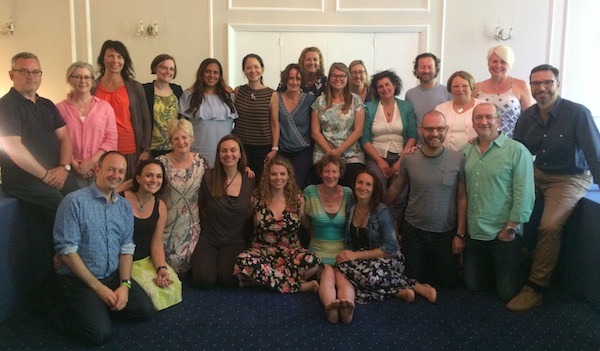
The wonderful students & faculty of London PCC “Q” celebrating their graduation in June