Summer 2015
Relationships That Matter: Generating Them/Repairing Them
Almost everyone says that relationships are the most important part of her/his life. With few exceptions, when asked, people will say that their family, or partner, or community is foundational—that everything they do is for the sake of those relationships.
Featured Article • Relationships That Matter
Relationships That Matter: Generating Them/Repairing Them
by James Flaherty
Often I can’t tell if these statements are true (what the speaker actually experiences) or are simply the saying of what we have been taught/socialized into saying. But I do know that, even when we lose track of them, ignore them, exploit them, deny them, run from them, relationships are constitutive of the being we are.
As clearly shown in the extraordinary book Heidegger’s ‘Being and Time’: A Reader’s Guide, even when we are geographically separate, our identity, our concerns, our possibilities are inseparable from other people.
Of course, a moment of reflection will reveal this to you—we don’t need Heidegger to say it but sometimes we get deluded/confused/lost in our own concepts that spin us far away from the way we are actually living. At that point, his strong assertions can help us, remind us. Especially for us Americans who think we are most real when acting from our individuality, his words can be the splashing cold water we need to awaken from cultural blindness.
As you likely know, scores of rigorous studies show that people with relationships are happier (here’s a link to an important study).

And yet what do we know about initiating and repairing close-in, intimate relationships? I don’t just mean romantic, sexual relationships but also those we have with our friends, children, colleagues and so on.
What would you say has these work? What do you do when they stop working?
An important work colleague and friend recently told me about the book reviewed in this issue of Distinctions: Parenting Without Power Struggles, which references the work of Gordon Neufeld and Gabor Maté, Hold On to Your Kids: Why Parents Need to Matter More Than Peers. Neufeld and Maté have taken attachment theory research and applied it to parent-child relationships and, by extension, to any relationship that matters to us. They have invented a simple, straightforward vocabulary that lays out a path for building important relationships and mending them when necessary. I have been experimenting with their framework and am finding it immediately usable, even with clients who are not very skillful in human interaction.
The background of their method is that we humans can tell when someone is sincere and real in the different stages of relationship. Huge parts of our nervous system are dedicated to being able to tell what is happening in our social surround. Knowing who to trust/open to is essential for our physical and emotional survival so we humans have gotten very good at it.
So these distinctions are not for manipulation but for our learning to take skillful action. As you read through them, maybe you will understand what is happening in your own intimate/important relationships—how they got started and why they are in their current condition.
The Stages
- Proximity: we want to be around this person; we enjoy their presence. We are not distracting ourselves when we are with them, making excuses not to be with them or finding ways to cut the time short when we are with them. How many parents really do all they can to not be with her teenagers (they don’t like them) and then wonder about their children not wanting to be with them on vacation?
- Shared Interests: we like to do things together or talk about things together. Could be that we like the same foods or the same music or cities or artists or dogs and so on, or that we have a shared history that we can talk about.
- Providing Support/Loyalty: we are available when needed, we empathize with them, we bring all the resources we can to assist them, we stand up for them and they know this about us because we keep showing it. We don’t have to think they’re perfect but we see their side and advocate for them.
- Significance: what’s important to them is important to us simply because it’s important to them and not because that’s what we like or what we would pick. So if our child is into sailing it’s important to us (remember we can’t fool anyone here) or if our colleague is taken by his local sports team or her favorite painter they become important to us.
- Love: our warm, personal caring and deep positive regard for them is shown in our gestures, tone of voice, playfulness, how we look at them and, in some relationships, how we touch them—and they feel held, warm, seen and accepted.
- Being intimately known: here both people involved in the relationship feel they can share their private interior life, their thorny issues, their deep fears and their secret dreams with much much less need for self protection and an ever-diminishing need for image management.
What happened when you assessed your relationships with these distinctions? What could you strengthen? Are you going to mend some of your relationships based upon these notions?
How do you bring these to your coaching clients? Do all of them apply?
I recommend you take up the study and application of this method because relationships are who we are and we can always become more skillful with them.
More on the topic in the book review, practice and poems in this issue.
Take care of yourself.
Love,

Practice • Generating/Repairing Close-In Relationships
Focus: Generating/Repairing Close-In Relationships
Please take up this practice for 30 to 45 days.
Please read the lead article in this issue for background.
Each day select someone with whom you want to begin or repair a relationship that is close-in and important to you.
Begin by assessing where you are in the 6 stages: proximity, shared interests, providing support/loyalty, significance, love, and being intimately known.
Next, sense into/think about what action you could take to cultivate the stage or repair it as necessary. In some cases it might be necessary to stop taking certain actions. Please reach out for support as you feel the need.
At the end of each day, reflect back on the efficacy of your efforts and take what you learned into your actions the next day.

Poetry & Reading
Poems of the Quarter
Personal Poem
Norman Fischer
I’m too personal to be me I’m me
I’m too you to be me I’m you
I’m too personal, yielding to my consequences.
Too before, too after
Too later, so much zero I can’t be counted among them
I’m a particle a wave
That square of sunlight unleashed across a rug
The patch in which I’m seen

When at a Certain Party in NYC
Erin Belieu
Wherever you’re from sucks,
and wherever you grew up sucks,
and everyone here lives in a converted
chocolate factory or deconsecrated church,
without an ugly lamp or souvenir coffee cup
in sight, but only carefully edited objects like
the Lacanian soap dispenser in the kitchen
that looks like an industrial-age dildo, and
when you rifle through the bathroom
looking for a spare tampon, you discover
that even their toothpaste is somehow more
desirable than yours. And later you go
with a world-famous critic to eat a plate
of sushi prepared by a world-famous chef from
Sweden and the roll is conceived to look like
“a strand of pearls around a white throat,” and is
so confusingly beautiful that it makes itself
impossible to eat. And your friend back home—
who says the pioneers who first settled
the great asphalt parking lot of our
Middle, were not in fact heroic but, really,
the chubby ones who lacked the imagination
to go all the way to California—it could be that
she’s onto something. Because, admit it,
when you look at the people on these streets,
the razor-blade women with their strategic bones
and the men wearing Amish pants with
interesting zippers, it’s pretty clear that you
will never cut it anywhere that constitutes
a where, that even ordering a pint of tuna salad in
a deli is an illustrative exercise in self-doubt.
So when you see the dogs on the high-rise elevators
practically tweaking, panting all the way down
from the 19th floor to the 1st, dying to get on
with their long-planned business of snuffling
trash or peeing on something to which all day
they’ve been looking forward, what you want is
to be on the fastest Conestoga home, where the other
losers live and where the tasteless azaleas are,
as we speak, halfheartedly exploding.
Poem
Rachel Zucker
One evening the husband yelled, “Ew! You smell like a rotten egg!”
The husband yelled, “Disgusting! Disgusting! Disgusting!” as he rolled around with their little boy, tickling him and smelling the little boy’s feet. The little boy laughed and shrieked and laughed so hard he struggled to catch his breath.
“Stop!” begged the boy, who wanted it to go on forever.
She wiped down the counters in the kitchen, surprised to feel a nut of envy hardening in her belly. She wanted to be touched that way. No, not that way.
Mayakovsky
Frank O’Hara
1
My heart’s aflutter!
I am standing in the bath tub
crying. Mother, mother
who am I? If he
will just come back once
and kiss me on the face
his course hair brush
my temple, it’s throbbing!
then I can put on my clothes
I guess, and walk the streets.
2
I love you. I love you,
but I’m turning to my verses
and my heart is closing
like a fist.
Words! be
sick as I am sick, swoon,
roll back your eyes, a pool,
and I’ll stare down
at my wounded beauty
which at best is only a talent
for poetry.
Cannot please, cannot charm or win
what a poet!
and the clear water is thick
with bloody blows on its head.
I embraced a cloud,
but when I soared
it rained.
3
That’s funny! there’s blood on my chest
oh yes, I’ve been carrying bricks
what a funny place to rupture!
and now it is raining on the ailanthus
as I step out onto the window ledge
the tracks below me are smoky and
glistening with a passion for running
I leap into the leaves, green like the sea
4
Now I am quietly waiting for
the catastrophe of my personality
to seem beautiful again,
and interesting, and modern.
The country is grey and
brown and white in trees,
snows and skies of laughter
always diminishing, less funny
not just darker, not just grey.
It may be the coldest day of
the year, what does he think of
that? I mean, what do I? And if I do,
perhaps I am myself again.
Book of the Quarter
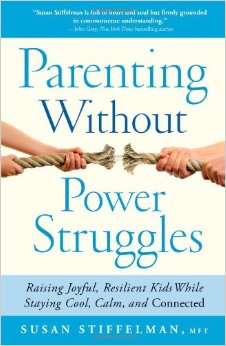
Parenting Without Power Struggles: Raising Joyful, Resilient Kids While Staying Cool, Calm, and Connected
Susan Stiffelman — Atria Books, 2012 — Paperback, 320 pages
May be a book you wouldn’t pick up unless you were a parent having some difficulties, but one certainly worth reading, with applicability far beyond the parent-child relationship. The book’s main power comes from the author’s reinterpretation of attachment theory: a popular, grounded understanding of how our early bonding experiences with caregivers shape all our subsequent relationships. Usually attachment theory is used to describe what happened in our early lives or understand current relational difficulties. I’ve never seen it used as a generative method of initiating/repairing intimate relationships (important ones where we have continuous close contact).
We probably all know it’s important to listen in relationships and do our best to empathetically connect, but what to do beyond that can be mysterious—and what to address when there is unwanted distance or lack of warmth can be confounding. The author provides plenty of practical advice and clear examples, and she cites references and studies that make the work readily accessible and trustworthy.
Just this past week I recommended that an executive having difficulty with his peers take on these principles and he clearly saw the point, which was quite something given that he’s not that sensitive or competent in relationships. For decades he’s received feedback that he was too gruff, too aggressive, too self-centered in his work. For the first time he saw an understandable and actionable path forward.
And that’s not even what the book is aimed towards. For parents with teenagers they want to be closer to, this book is an extraordinary gift and guide.
A very worthwhile addition to any parent’s/coach’s bookshelf.
— James Flaherty
News & Updates
Everyday Zen Dialog with James Flaherty and Chris Fortin
For students and graduates in the San Francisco bay area, this daylong retreat is an opportunity to learn from James in a different context and community. To register, email [email protected].
Update from the 2015 PCC Leader Retreat
by Anamaria Aristizabal
The faculty retreat this year led to a bountiful harvest of togetherness and collective learning. Surrounded by the beauty of the south Spain landscape, near the town of Otivar, the faculty shared meals, walks, and outings together, to nourish the field of relationships and learning that contribute to our collective purpose of creating fresh and powerful developmental experiences for our students. The design, led by Sarita Chawla and Charles Brassard, provided a beautiful framework for the rich conversations for relationships and possibility that happened throughout the week. Topics included: felt sense, client-coach relationships, the spiritual stream, coaching in balance, and conversations subsequent to the initial coaching conversation.
Celebrating Mandela Day
Honoring the leadership spirit of Nelson Mandela, our partners at the Centre for Coaching in South Africa offered free coaching sessions to emerging leaders this Mandela Day (July 18). As organisations and individuals across South Africa turned out to do their 67 minutes of good (in tribute to the 67 years of his life Mandela gave to the struggle for human rights and social justice), the Centre facilitated a series of one-on-one coaching sessions tailored for individuals and organisations who want to grow their leadership skills and discuss the way forward with an experienced leadership coach.
Faculty in the news
Senior faculty member Janine Everson is featured in an inteview series, “The Secrets for Success in Coaching” on the Swiss financial news network Ducascopy. We’re always thrilled when Janine’s wisdom is made available to the wider world. Happy watching!
A successful inaugural course in Europe
Congratulations to the 16 graduates of the first six-month Associate Coaching Course offered in Switzerland by the Swiss arm of Centre for Coaching. The next course begins in September at the Château de Bossey, near Geneva, Switzerland.
Graduate News
Congratulations and welcome to our new graduates!
Antoinette Biehlmeier, Singapore
Wendy Carmody, Menlo Park, CA, USA
Sumita Datta, Mumbai, India
Howard Davis, Oakland, CA, USA
Rhea Dsouza, Mumbai, India
Cortney Erin, San Francisco, CA, USA
Anu Ghosh, Singapore
Doreen Goh, Singapore
Christophe Grimont, Ho Chi Minh City, Vietnam
Dan Handalian, San Bruno, CA, USA
Liz Harris, Cottesloe, Australia
Marilyn Harris, Oakland, CA, USA
Kah Keh Ho, Singapore
Khai Hong, Singapore
Jean-Francois Jadin, Kuala Lumpur, Malaysia
Verna Jaggers, Santee, CA, USA
Saeko Kani, Tokyo, Japan
Tamiko Kawashima, Tokyo, Japan
Vivek Khemka, New Delhi, India
Marijana Kolak, London, United Kingdom
Ed Kolber, Dubai, UAE
Rene Leger, Portland, OR, USA
Sanne Lim, Palo Alto, CA, USA
Danielle Mackowski, Singapore
Amanda Moody, Singapore
Bridget Morris, Denver, CO, USA
Carla Morton, San Anselmo, CA, USA
Sandy Oetterli, Wong Chuk Hang, Hong Kong
Kristina Owyoung Vinson, Mountain View, CA, USA
Eric Rajendran, New Delhi, India
Guy Rom, Los Altos, CA, USA
Gayle Scott, Boulder, CO, USA
Loren Shuster, Singapore
George Strang, San Francisco, CA, USA
Ogie Strogatz, Walnut Creek, CA, USA
April Swando Hu, Singapore
Sarah Toney, Reno, NV, USA
Shankar Vedagiri, Maharashtra, India
William Wandall, Mill Valley, CA, USA
Cecile Weber Duque Bregon, Singapore
Alan Wilson, Doha, Qatar
Nikita Yefimova, San Francisco, CA, USA
Dorothy Zhuomei, San Francisco, CA, USA