Self-improvement and self-development are often used interchangeably — but they describe fundamentally different relationships to growth. Self-improvement asks: what is wrong with me that needs fixing? Self-development asks: what is trying to emerge in me that needs tending? This distinction shapes everything about how coaching works — and how you live.
This article was originally published on the Mindful Leader blog in May 2022. It has several questions for reflection in italics. In these places, you’re invited to pause, feel into your response, and perhaps explore a bit with some notes or journaling.
“To be purposeful is not to be goal oriented, but to seek to reconnect to the source of one’s life.”
― Michael Meade
What is Self-Improvement?
Oftentimes in life, we may encounter a deep desire to fix, correct, or upgrade something within. The feeling is that when we look inward, we see parts of ourselves that we feel are lacking something. One way we notice this space in ourselves is when we feel a gap between who we are and who we think we should be, and we start making plans to close it.
Imagine you are in a foreign country and facing language barriers. You realize that learning the local language will help you connect better with others, so you endeavor to reach that goal by learning a specific skill. That in itself is positive, but as an orientation to a whole life, it tends to treat the self as a problem to be solved and keeps our attention on what’s missing versus what is alive in us.
What is Self-Development?
Self-development is the process of recognizing and supporting what is already growing in us (and listening to it!). Instead of starting from the point of view that there’s a problem/deficit, it starts from a longing that pushes from within and wants to come forward. And in this “coming forward”, we can make room for it to happen. That is also how New Ventures West orients towards Integral Coaching.
The Organic Nature of Growth
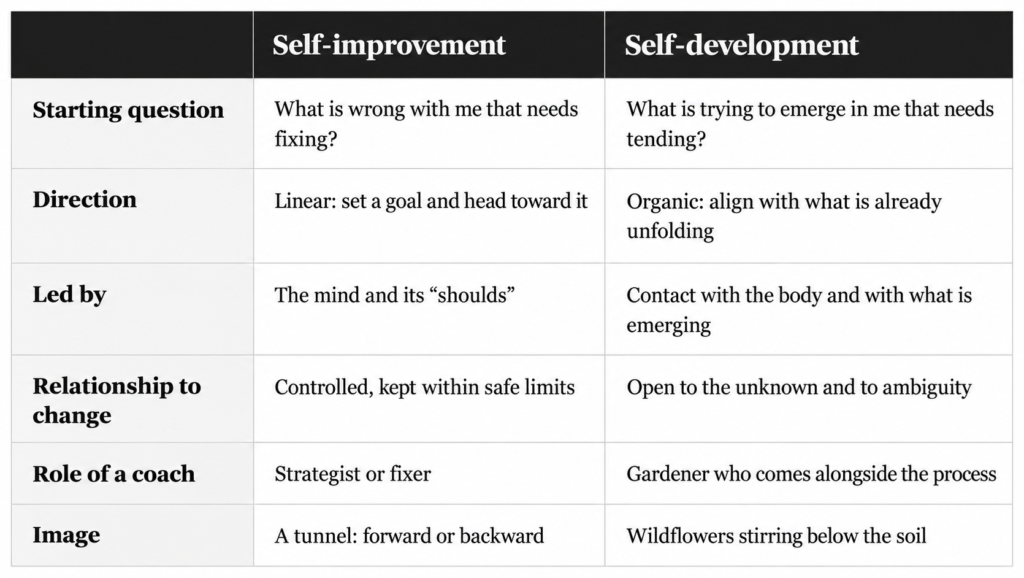
In a recent video (which you can watch at the bottom of this post), faculty member Adam Klein draws a distinction between self-improvement and self-development. To paraphrase, development is about aligning with the natural process of being alive, and with the longing to express what is coming forward in us. He likens Integral Coaches to gardeners tending to this growth in clients in that we are not forcing or strategizing about their development; rather, we are coming alongside the natural process of unfoldment.
Notice the organic feeling of this. Growth in this context is not a linear, driven process. It’s not about identifying a goal and heading unstoppably in that direction (which tends to be the spirit of self-improvement). Instead, much like the wildflowers stirring just below the surface of the soil in early spring, people can feel stirred by something that wants to be fully expressed in the world—indeed, something that will be expressed, if we allow it.
Key Differences
The easiest way to tell the difference between self-improvement and self-development is to look at the question each begins with and what each focuses on.
What the Difference Looks Like in Real Life
Consider two leaders seeking coaching. The first leader aims to address an abrupt communication style and measures success by the absence of complaints. This is a reasonable improvement request. The second one notices a shift in their approach, such as impatience with small talk and a desire for more honest conversations, and seeks to understand its meaning before taking action. This is a development question, which leads to a different coaching experience.
Another example is two people seeking a new relationship with time. One person enrolls in a productivity course to accomplish more each day. The other one adopts a sitting practice, not for output, but to understand why time feels scarce. Both respond to real concerns, but only the second explores the underlying cause of the pressure. In both examples, the development path resembles that of the gardener, who observes what is emerging before deciding how to proceed.
Signs You Are in a Development Orientation
A development orientation is usually quieter than an improvement one, and it tends to show up in the body before it shows up as a plan. You may be in it if:
- You sense something stirring in yourself that you can’t quite name yet, but you are willing to leave it unnamed for a while
- Your curiosity about what is happening is stronger than your urge to fix it.
- Strong feelings, even uncomfortable ones, register as information rather than as problems.
- You can tolerate some ambiguity about where things are headed.
Can you sense a stirring in yourself right now? Feel into the center of you, the pit of your stomach, the place right behind your belly button, your creative seat. Take a few deep breaths, and sense into what is there, what is waiting to be known or expressed. It may not be a clear picture or something you can name. Perhaps it’s simply a sensation, a sound, or a color. Take a moment to jot down whatever you sense.
Signs You Are in an Improvement Orientation
An orientation towards improvement can arrive as a reflex, with the mind rushing in to decide, fix, or dismiss… before anything has had time to take shape.
The Stifling Nature of Fear
Sometimes (OK, often) when I do this exercise, my brain jumps to immediate conclusions: “oh, this must mean I should do X.” Either that or it serves up an excellent list of reasons why whatever it is is insane and impossible. The superego’s voice quickly takes the controls and starts making assertions that have very little to do with that tender, unfolding thing, so that it’s either ripped out of the ground too soon, or snuffed out before it’s had a chance to become anything at all.
Does this happen to you as well?
This is actually quite normal. As biological beings, we are bound by homeostasis. If an aspect of our physical being goes out of whack, our system will do its best to bring it back into balance. For example, if our internal temperature deviates a degree or less, we shiver or sweat. Two or three degrees, we’re likely sick. Not much more than that and we’re in danger of dying. According to our most basic nature, change does not correlate to survival. Fundamentally, despite our best intentions, we avoid it.
Similarly, the superego’s job is to ensure spiritual and psychological homeostasis. Considering how most of us in the west were trained and educated, we rely far more on what our minds say than what our bodies know. From there, it’s difficult to be in contact with what is true and emerging in ourselves, for others, or in the world.
Meanwhile, as we well know, change is the only certainty. Life is constantly asking us to expand further outward to meet it in its freshness.
Consequences in the World
On a global level, this dilemma is what is choking us—and what always has. Oppression, control, abuse, greed, misinformation and more have roots in the collective superego; namely, its attempts to keep us from reaching into the new possibilities offered up to us by Life every day. This is because genuine growth brings with it the unknown, it requires imagination and comfort with ambiguity, and is therefore a threat to homeostasis. Some responses to this threat might sound like – “People can’t just do whatever they want.” “They don’t know what’s good for them.” “There is no precedent for this.”
Unstoppable “progress” is another symptom of this restrictive fear. Striving, moving forward, “improving” ourselves and our surroundings has us bypass contact with ourselves and any real sense of what is actually needed. In this orientation, life is a tunnel and the only movement is forward or backward. Forward is the only option if we are going to live. Never mind that we’re blind to what is outside the tunnel walls. The only questions available here are ones like, “Where is the profit?” “What is the end game?”
Can you feel the restriction of this orientation, and how few possibilities it allows for? What does it feel like in your own body?
This is showing up in myriad ways this very week. The Russian invasion of Ukraine. The ‘Don’t Say Gay’ bill in Florida. Continued political division.
What other ways can you find that this is playing out right now?
Some signs you may be in an improvement orientation:
- you begin from what is wrong with you rather than what is alive in you
- you move straight from a feeling to a to-do (“this must mean I should do X”)
- an inner voice supplies reasons the new thing is unrealistic or impossible
- progress only counts if it is measurable and moving forward
- the questions that come most easily are about payoff and the end game
How to Shift from Improvement to Development
Shifting from improvement to development is less a technique than a change in where you put your attention: away from the mind’s verdicts and toward direct contact with what you are sensing. A few practices from this article can help:
- 1. Pause before you plan. When something stirs, give it time before turning it into a goal.
- 2. Check in with your body. Return to the reflection above and notice sensations before conclusions.
- 3. Hear the inner critic as a voice, not a verdict. When the list of reasons it can’t work appears, recognize it as homeostasis doing its job.
- 4. Expect discomfort. Real growth passes through awkward stages, including the agony of conscious incompetence (link → NVW conscious incompetence post), and that discomfort usually means something is changing.
- 5. Stay in contact with what you feel about the world. As the next passage explores, even rage and despair can be signs that you are awake to your life.
Tending Our Own Gardens
The world’s deep pain is ages old, impossibly complex, and there are no clear solutions. The rage, despair, and hopelessness we might feel when thinking about this are actually signals that we are indeed in contact with ourselves. This is a necessary aspect of being awake in the world today. In fact, accessing and deepening this contact is one of the most vital things we can do for ourselves and others. Painful, yes, but it’s not all anguish. Keeping the roots of our ever-growing self planted deeply in the soil of self-knowing allows us to sense more widely in all directions, and to feel when it’s time to expand a little further outward into Life.
Why This Distinction Matters for Coaching
The difference between improvement and development sits at the core of Integral Coaching. An Integral Coach comes alongside the natural process of unfoldment, helping clients see what is emerging in them and giving it room to grow. You can read more about how Integral Coaching approaches development.
The path of self-development that is Integral Coach training involves much that can help us in cultivating this way of being: mindfulness, somatic practices, self-reflection, philosophical and scientific study, a strong community of support, and lots else. In this container, you will discover new ways of being in contact with yourself by exploring how your superego (and other constructs) might be blocking your life’s full expression. And you will learn to skillfully engage in this exploration with others, by meeting them where they are and tending to their emerging garden in ways that will help it thrive.
There is an adage that if many separate puddles rise high enough they eventually join together to form a lake—something much harder to ignore than a puddle. Similarly, if we cultivate the garden of our own unfoldment and support others in reaching for what is genuinely possible, well … we may not reforest the planet, but it may just be that we’re infusing the world with a little more breathable air.
Frequently Asked Questions
Q1: What is the difference between self-improvement and self-development?
Self-improvement focuses on fixing what we believe is wrong with us, usually by setting a goal and working steadily toward it. Self-development focuses on noticing and supporting what is already trying to emerge in us. The first starts from a deficit and relies on the mind’s plans, while the second starts from a longing and relies on contact with what we sense and feel.
Q2: What is self-improvement?
Self-improvement is the effort to correct or upgrade a part of ourselves we have judged to be lacking, such as a habit, a skill, or a trait. It is typically linear and goal-driven, and it measures success by how far we have moved from where we started toward where we think we should be.
Q3: What is the difference between development and improvement?
Improvement makes something that already exists better by a known standard, such as faster, more efficient, or more polished. Development changes the thing itself, where new capacities and ways of being emerge that weren’t available before. In personal growth, improvement refines who you are now, while development changes who you are becoming.
Q4: Is self-development the same as self-improvement?
No, although the terms are often used interchangeably. They describe different relationships to growth: self-improvement asks what needs fixing, and self-development asks what needs tending. The difference shapes how you set goals, how you handle discomfort, and what kind of support, including coaching, will actually help.
Q5: Which is better: self-improvement or self-development?
Neither is wrong, and each has its place. Self-improvement works well for learning a specific skill or changing a specific habit. Self-development is a better fit for questions about purpose, identity, or how you want to live, because you can’t solve those with a plan. Integral Coaching focuses on development because it cares about how people grow, not only what they fix.
Integral Coaching is built on the distinction between improvement and development. If you’re curious what that looks like in practice, join us for Foundations of Coaching.