Autumn 2017
Intentional Suffering: What it Takes to Wake Up and Develop
For decades we at New Ventures West have been saying the purpose of our programs is to lessen suffering. So what’s up with the title of this article? Am I proposing some form of hair-shirt, puritanical, inner-critic self-flagellation?
Featured Article • Intentional Suffering: What it Takes to Wake Up and Develop
Intentional Suffering: What it Takes to Wake Up and Develop
by James Flaherty
For decades we at New Ventures West have been saying the purpose of our programs is to lessen suffering. So what’s up with the title of this article? Am I proposing some form of hair-shirt, puritanical, inner-critic self-flagellation?
Why would you or me or anyone intentionally take on suffering?
Well, first of all, we have all done so and likely do it every day. We tend to our spouse/partner, our children, our friends, our pets, our plants when it is uncomfortable—sometimes even painful. We hold difficult yoga poses, sit in meditation while our emotions rage, swim or run the extra 500 meters, squirm as we find the perfect word for our poem, screw up our courage to say “I love you” or “I’m sorry” or “I forgive you.” No one makes us. We know it won’t feel good, that it will hurt… and we do it.

So in a way I’m not bringing up anything particularly radical, once we stop and reflect on our life for a moment. Still, it’s true that we sometimes—maybe even often—step back from what we’ve committed to, what feels right to do, what’s in our best interest, what would deepen our development, when we anticipate suffering in any of its multiple forms.
For you, how is it that sometimes you step into the suffering and sometimes away from it?
You will find out so much about yourself as you honestly, candidly ponder this question in open self-inquiry. I certainly have.
Intentional suffering fits into the middle of the inquiry. It’s the discomfort, discouragement, disillusionment, discombobulation, despair, shame, embarrassment and so on that show up in our experience when we begin to take a long, hard look at ourselves.
Usually, and for the most part, most of us operate within severely restricted routines of repeated thoughts, predictably cyclical emotions, reactive and automatic behaviors. That would all be confining enough, but we also deny this as long as we can—until someone (a dear friend, new lover, spiritual guide, coach, boss, author, or other artist, or…) or something (an encounter with nature, a relational, financial or health breakdown, a powerful spiritual opening, and so on) undoes our denial/distraction and we directly encounter ourselves in the midst of our sticky, seemingly intractable patterns.
Here is a song that gives the feel of this territory.
And yikes! The emotions listed above strongly appear. We may be shocked. We have been gone from our real lives for a long time. We haven’t had a nonreactive feeling for a long time. Fresh thoughts have not appeared. We have been living in a very small cage.
We may immediately draw back. The pointing out or the event may appear like a flash of lightning, clearly showing what’s there but just for a moment. And yet, still, we’ve seen.
Once seen, the clarity and power of the event can awaken us—not by our by thinking about it, but rather by our being fully present with how much we are not present. You’ve had this experience. You know this.
What did you do next when this happened to you? What would you do now?
And here directly is where intentional suffering comes in. What we choose, open to, do next can affect our lives essentially, to our core, and for a long time afterwards.
We can turn back towards being asleep, at a distance from ourselves. We can spend our life merely coping from one difficulty to another, adding and crossing off items from our to-do list endlessly. We can follow popular culture and the opinions of our friends from one mirage of meaning to the next.
Or we can take up intentional suffering. We can suspend our harsh judgments of ourselves, which never go anywhere or help us very much. We can, each and every day, take up practices that show us directly what’s happening in our body, mind, heart and spirit. We can find relationships and groups in which we can unreservedly share our unfoldment.
Sometimes these activities will feel joyful and liberating, and maybe after many years they will be there more regularly. At first there will be unpleasant, difficult, painful experiences that arrive with no warning in the guise of being eternal.
Will you turn back then? What will keep you on the path? Will you deliberately, resolutely, continually remind yourself that you are on a path that you have embraced?
As coaches we can support our clients to consciously, willingly take on intentional suffering for the sake of fulfilling the purpose of their coaching engagement. Our question, often, is will we let our client be in these places?
Will we rewrite their program and deny them the chance to mature, come into their own?
Or will we accompany our clients into their unfoldment, which invariably includes suffering? For sure this becomes much more possible when we are on our path each day ourselves.
Are you?
Or have you lost your way?
How will you come back?
When will you start?
Who will be your companions?
What follows in the newsletter can assist you in addressing these questions. The poems give more nuance. The practice of the quarter will give you your own insights, and the book review will provide context and background for your inquiry.
Plus we have a new program, which I’m leading, that is directly on this point: what is my path? What am I leaving out? How can I stay on it?
The program is called The Integral Path and you can find out more about it here.
Take care of yourself.
Love,

Practice • Intentional Suffering
Focus: Intentional Suffering
Please read the lead article before taking up this practice.
Please engage this activity for 30 to 45 days.
Please stop three times per day and ask yourself the following questions and write down some notes so that you can begin to notice patterns.

Please stop every seven to ten days and write out the summary of what you are learning.
And please keep allowing the insights to shift how you are being/living.
During this period of time:
- Were there chances for me to turn towards what’s true? Towards the difficult?
- How did I respond to this opportunity? And what was the effect of my response?
- Do I have the sense/suspicion that I am turning away from something? What is that?
- How could I start turning towards this truth during this next period of observation?
Poetry & Reading
Poems of the Quarter
The Panther
Rainer Maria Rilke
Translated by Stephen Mitchell
His vision, from the constantly passing bars,
has grown so weary that it cannot hold
anything else. It seems to him there are
a thousand bars; and behind the bars, no world.
As he paces in cramped circles, over and over,
the movement of his powerful soft strides
is like a ritual dance around a center
in which a mighty will stands paralyzed.
Only at times, the curtain of the pupils
lifts, quietly–. An image enters in,
rushes down through the tensed, arrested muscles,
plunges into the heart and is gone.

The Man Watching
Rainer Maria Rilke
Translated by Robert Bly
I can tell by the way the trees beat, after
so many dull days, on my worried windowpanes
that a storm is coming,
and I hear the far-off fields say things
I can’t bear without a friend,
I can’t love without a sister.
The storm, the shifter of shapes, drives on
across the woods and across time,
and the world looks as if it had no age:
the landscape, like a line in the psalm book,
is seriousness and weight and eternity.
What we choose to fight is so tiny!
What fights with us is so great.
If only we would let ourselves be dominated
as things do by some immense storm,
we would become strong too, and not need names.
When we win it’s with small things,
and the triumph itself makes us small.
What is extraordinary and eternal
does not want to be bent by us.
I mean the Angel who appeared
to the wrestlers of the Old Testament:
when the wrestlers’ sinews
grew long like metal strings,
he felt them under his fingers
like chords of deep music.
Whoever was beaten by this Angel
(who often simply declined the fight)
went away proud and strengthened
and great from that harsh hand,
that kneaded him as if to change his shape.
Winning does not tempt that man.
This is how he grows: by being defeated, decisively,
by constantly greater beings.
The 8th Duino Elegy
Rainer Maria Rilke
Translated by Robert Hunter
Animals see the unobstructed
world with their whole eyes.
But our eyes, turned back upon
themselves, encircle and
seek to snare the world,
setting traps for freedom.
The faces of the beasts
show what truly IS to us:
we who up-end the infant and
force its sight to fix upon
things and shapes, not the
freedom that they occupy,
that openess which lies so deep
within the faces of the animals,
free from death!
We alone face death.
The beast, death behind and
God before, moves free through
eternity like a river running.
Never for one day do we
turn from forms to face
that place of endless purity
blooming flowers forever know.
Always a world for us, never
the nowhere minus the no:
that innocent, unguarded
space which we could breathe,
know endlessly, and never require.
A child, at times, may lose
himself within the stillness
of it, until rudely ripped away.
Or one dies and IS the place.
As death draws near,
one sees death no more, rather
looks beyond it with, perhaps,
the broader vision of the beasts.
Lovers, serving only to obstruct
one another’s view of it,
approach the place with awe…
as if by accident, it appears
to each behind that precise spot
before which the other stands…
neither can slip behind the other
and so, again, the world returns.
We behold creation’s face as though
reflected in a mirror
misted with our breath.
Sometimes a speechless beast
lifts its docile head
and looks right through us.
This is destiny: to be opposites,
always and only to face
one another and nothing else.
Could that surefooted beast,
approaching from a direction
different than our own, aquire
the mental knack to think as do we,
he would spin us round
and drag us with him.
But he is without end unto himself:
devoid of comprehension,
unselfscrutinized, pure
as his outgoing glance.
We see future; he sees
eternal completion.
Himself in all.
Even so, within the alert warmth
of that animal, the weight and care
of one great sadness dwells.
He is not exempt from an unclear
memory-which subdues us as well:
the notion that what we seek was once
closer and truer by far than now…
and infinitely tender.
Here… distances unending.
There… a gentle breathing.
After that first home, this one
seems windstruck and degenerate.
O bliss of the diminutive:
creature born from a particular womb
into womb perpetual.
O delight of the mite who
leaps on, embryonic, though
his wedding day impends!
All is womb to him.
But observe the lesser
certainty of the birds
who seem to know both
circumstances, by
very birthright, like
some Etruscan soul rising from
the cadaver of a sarcophagus
sculpted with its tenant’s face.
Imagine the general bafflement
of anything born of the womb
and required to take flight!
Frightened by its very self, it
cuts the air with fractured arcs,
jagged as bat tracks, cracking
the porcelain sky of evening.
We are, above all, eternal spectators
looking upon, never from,
the place itself. We are the
essence of it. We construct it.
It falls apart. We reconstruct it
and fall apart ourselves.
Who formed us thus:
that always, despite
our aspirations, we wave
as though departing?
Like one lingering to look,
from a high final hill,
out over the valley he
intends to leave forever,
we spend our lives saying
goodbye.
Book of the Quarter
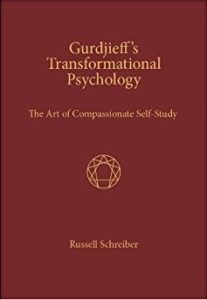
Gurdjieff’s Transformational Psychology: The Art of Compassionate Self-Study
Russell Schreiber
Present Moment Press, 2013
Hardcover: 464 pages
Gurdjieff (1844-1949) was a mystic and teacher who wrote notoriously dense texts and whose work is difficult to access, even through practice centers existing around the world.
Fortunately for us, then, is finding the recent book by Russell Schreiber, a practicing psychotherapist and long-term student of Gurdjieff’s work. In his generous, clear text, he lays out the foundational principles of what’s called “The Work,” and illustrates them with contemporary examples that we all can follow.
Throughout the book the author refers to his own unfoldment and what it took for him to discover the truth of what seemed very strange at first in Gurdjieff’s teaching. We are welcomed in by the stories, which make it possible for us to consider the application of these principles in our own everyday lives.
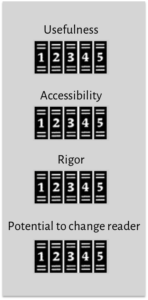
The book is replete with accessible, simple, yet profound practices we can employ in finding out for ourselves the truth of what’s written and pointed to.
As coaches we can readily bring these practical exercises into our client work.
Besides all that, the book has a glossary, is regularly footnoted to primary and secondary sources, and has a robust index.
This book will save you five to ten years of researching through many books to collect the specific details of what Gurdjieff taught, and yet the writing maintains the challenging edginess of its sources.
An outstanding example of making essential, transformational understanding available and immediately applicable. Nowhere else in one place does this wisdom appear—don’t miss it.
— James Flaherty
News & Updates
Year Launch 2018
Not Turning Away: Facing All of Life with Courage, Strength and Compassion
A message from James:
Our shared world is being disrupted, rearranged, collapsing in many ways. How will we respond?
The first essential step is being able to fully face the situations in our shared and individual worlds. We too easily distract ourselves, pointlessly complain and gossip, throw up our hands in resignation.
We then abandon our vision, undercut our strength, dilute our genuine compassion, and replace it with pity and blaming others.
We can, however, re-find our feet and stand with resolve and dignity, reawaken our courage and intelligent sensitivity, reoccupy our hearts and our connections to everyone, no matter how we think or feel about them.
This project may be the most important one for our time. Please don’t neglect it.
Stepping In Podcast
The latest episodes of the Stepping In podcast take up this topic in a multi-part conversation between James Flaherty and Adam Klein. Listen now.
Turning Towards Life
A weekly study group
There are so many ways to go to sleep to life, to turn away from ourselves and one another. But the world needs us each to bring ourselves as fully as we can. This group, hosted on Facebook by London faculty members Lizzie Winn and Justin Wise, is dedicated to waking up to life so we may turn towards what’s called for in the world and its many uncertainties.
The 30-minute sessions take place on Sunday mornings at 9am GMT (and are recorded for those who can’t make it at that time). Justin or Lizzie offer a source (poem, reading, blog post, etc.) the previous Friday to serve as a basis for the conversation.
You can learn more and join the group here.
PCC à Paris!
The first ever PCC in Paris began last month. At right: faculty members Renée-Pascale LaBerge, Jean-Louis Perrod, and Jean-Philippe Bouchard gear up for day one. Not pictured: Charles Brassard. Félicitations à nos amis!
Sixteen superegos slain in Singapore
Since 2011, Sarita Chawla has been empowering students worldwide in her popular workshop, Thwarting the Inner Critic. The last course of the year is coming up on December 1-2 in Ottawa. It is open to all—not just coaches. Click above to learn more.
Meanwhile, in Argentina …
Congratulations to the recent graduates of the Associate Coaching Course – Coaching for Development in Buenos Aires led by the wonderful Fabian Di Felice.
Graduate News
Letter from the Graduate Department
Dear friends,
As Integral Coaches we are committed to easing suffering. These days, there is so much apparent, undeniable, large-scale suffering that it’s hard to know in which direction to turn. The world’s crises, difficulties, endings, revelations, and pain can take us out of ourselves, either flying outward toward the loudest need or retreating away from it into our own heads, our own busyness. While these approaches might provide some short-term relief, they aren’t sustainable. It’s especially important now to be grounded in ourselves and fluid in our response, attuning to whatever it is that calls to us uniquely, and cultivating the capacity to answer that call with our whole being.
Hence the timeliness of James’s upcoming Year Launch program. We hope you’ll take his invitation to heart, and consider participating as an expression of your continued dedication to serve. We’re so grateful for this community.
Love,
Sahar Azarabadi & Adam Klein
Congratulations and welcome to our new graduates!
Karen Andujar, Annandale, VA
Dawn Angelo, Sacramento, CA
Lizzie Azzolino, San Francisco, CA
Anne-Marie Brest, Portola Valley, CA
Graeme de Villiers, Johannesburg, South Africa
Jacqueline Duncan, San Francisco, CA
Natalie Fair, Los Altos, CA
Catherine Fourmond, San Francisco, CA
Bob Galowich, Chicago, IL
Jonathan Hoyt, San Francisco, CA
Lucia Kimble, Oakland, CA
Eva Kuehnert, Scottsdale, AZ
Kingsley Lenkokile, Johannesburg, South Africa
Nicole Lewis, Pasadena, CA
Lorato Mosetlhanyane, Gabarone, Botswana
Maggie Murphy Maertz, San Diego, CA
Laurie Parodi, Pacifica, CA
Ivanna Peretyagina, Moscow, Russia
Thomas Rosenberg, Oakland, CA
Deb Schwinn, Coralville, IA
Richard Sorge, Anchorage, AK
Alexa Stafford, Johannesburg, South Africa
Suzanne Taylor, Menlo Park, CA
Becky Weber, Lenexa, KS
Colleen Wood, Yountville, CA