Winter 2022
The real power of unconditional acceptance
As someone who has prioritized growth and development for decades, I have found myself in more than a few groups dedicated to change and healing—before, since, and very much during the Professional Coaching Course. And in my communications role at NVW I’ve spoken and written countless times about how important the community of practice is in the work we do. It was only recently, however, that I fully came to understand with my whole being what is behind the transformative power of groups like this.
Featured Article • The real power of unconditional acceptance
The real power of unconditional acceptance
by Joy Reichart
What they all have in common – all these places where I’ve experienced so much growth, discovery, joy, despair, pain, bliss – is that they are places of unconditional love and acceptance. And in fact, without that, none of the Very Important Work that I’ve so doggedly pursued would have happened, or even been possible. Unconditional acceptance is the foundation of any group on a journey of growth. It has to be.
Of course, development isn’t solitary work
There are the more obvious reasons why it is difficult, if not impossible, to grow on our own. Shared experience is an essential element of development. We need mirrors; we need folks to point out what we aren’t seeing. We need to know there are others around us who can relate to what is happening. Having the chance to support our peers gives us a stronger sense of fulfillment and purpose in our shared pursuit. We meet people who perhaps wouldn’t otherwise come into our orbit, expanding our understanding of the world and the people who live in it, giving us glimpses into the infinite ways a life can be lived, deepening our empathy and humility… and so forth.
All of this is wonderful. It is necessary. These truths have kept me on more than one journey when the work of it has felt impossible. And it is on this point that, aided by a marvelous therapist, I came to understand something important: for all these years, I’ve been holding the framework as: “Here I am doing this work (in this class, in this dojo, in this sangha) to improve myself, and oh, how lucky that I have these incredible friends doing it with me. The love I feel from this community is sublime, but it’s a byproduct of What I’m Actually Up To.”
The truth, it turns out, is precisely the opposite:
The love is kind of the point.
Despite what I believed or the reasons I gave for what I was up to (usually betterment of some kind), the love and acceptance is actually why I sought these groups out—and (another mind-blower) that is OK. It is a natural human proclivity to move toward these spaces. In fact, it can be a goal. We can pursue unconditional love and acceptance for its own sake.
It is no wonder that my antenna has always been up for such places and, when I’ve found them, I’ve stayed close. Yes, for years it has been under the auspices of fixing or improving or developing myself. And indeed that has happened, though not alongside the love and acceptance, but because of it.
Supportive? Yes. Coddling? No.
When I say ‘unconditional love and acceptance,’ of course, I’m not talking about a circle of beatific, carefree people holding hands, swaying and chanting that all is well, and forgiving terrible transgressions. Nor is it about being exclusively praised or coddled or given infinite affordances.
A container of unconditional acceptance is one that makes no bones about the challenging journey you’re on. That says, “You are likely going to fumble, backslide, get scared, feel vulnerable, make mistakes, act out. You may fight the process or even want to quit. You’ll get uncomfortable and might project that onto your leaders and peers in all sorts of ways. And in all this, we love you, we see you, and we are not going anywhere.”
Ahhhh. AHHHH!
What a beautiful, settling concept. It is also one that can freak us the heck out. For many of us, after a lifetime of acting the ways our family or culture told us we must in order to be accepted, we’re suddenly invited to disarm, show up raw, and find out the truth about ourselves. There could be—and often is—relief at this possibility. There can also quite understandably be fear, suspicion, anger, shame.
One of my core issues has been a sense of unworthiness that had me regularly ‘testing’ many a guide and companion. “You don’t really want me here, do you? This has all been a terrible mistake, hasn’t it?” Looking back, I bow to the grace with which my very skilled teachers and peers have been with me in this—and still are. Holding up mirrors to that distortion until, finally, I could see that in fact I was—that I am—OK.
Spaces of true unconditionality give us room to be with these kinds of responses, feel them, and work with them from a more centered place of deeper capacity. What is that if not growth?
In other words, in an unconditional community, we have little else to do but encounter ourselves. And that—regardless of the shape of the path or the name of the work—is at the heart of development.
How has this happened for you? How do you do it for others?
If you have been through the Professional Coaching Course, maybe you can recall the responses you had to finding yourself in this unique container of unconditional love. Perhaps that response was the very thing that you spent your year working on, and you are a different person now because of it.
Whether it has been in the PCC or another developmental path, what themes have arisen for you in the vast, sometimes overwhelming freedom of unconditional acceptance?
The beautiful thing is that, once we’re on to this, we can begin to create these kinds of spaces for others—something sorely needed, especially now. More about this in the practice that follows.
For now, know that whenever you make the choice to take up a path of growth and deepening, in the PCC or elsewhere, you are likely entering a place where a very unfamiliar, very freeing, and very scary thing is happening. It takes courage to love and be loved this much. And it will change you forever.
Waving from the path,

Practice • Offering Unconditional Acceptance
Focus: Offering Unconditional Acceptance
I see a wonderful body worker who, like many good healers in her field, sometimes does things that hurt. Of course she isn’t trying to hurt me; she’s finding places in my body that are tight, closed off, wound up, or otherwise not free. She’s liberating them. And—as with any big liberation—it can be painful.
And in response I make sounds. Groans, little yelps, sometimes tiny sobs.
Her response to these cries? A gentle, almost cooing: “Yeah. Mmm. I know. Mhm.”
And that is the most healing part of these sessions: her letting the process be what it is. Letting me have my healing without managing my feelings about it. Being diligent in the work she’s doing, and compassionate in how she holds the space.
So here is the practice.
If you are a coach, you can work on this with your clients. Otherwise, maybe it’s with your kids, or your neighbors, or teammates, or someone on the bus.
The person is in pain. Hurt. Stuck. Having difficulty. Wrestling with something. Acting out. Being needy. Behaving “poorly.”
- For the first two weeks…
Notice your response. That’s all. What are you moved to do? Do you get angry? Do you dismiss them? Make up a story about them? Do you move quickly to point out how it’s really OK, that there’s no need for them to be upset? What does your body do?
Check it out. Journal about it at the end of the day. “What are all the ways I responded to people in pain today?”
- For the next two weeks…
Try something new. Insofar as it’s safe, explore the range of possible responses. If you habitually move in to soothe, what happens if you step back and make room? If you usually argue, what if you empathize? If you noticed a regular scattering energy in your body, what happens if you gather it in? If you usually contract, perhaps trying a gentle expansion.
- Ongoing…
Having explored what you habitually do and experimenting with what’s possible, start to look for that center point. Can you simply be in the presence of this person’s distress? What does it take? A longer meditation in the morning? A deeper sense of ground, bigger breaths? What is your version of my body worker’s “Oh yes. Mhm. I know. Mmm.”? What happens for the other person when you can hold that space?
Since the intention of this practice is gentleness, be gentle with yourself. You can always go back to simply noticing, which goes a long way toward change.
Poetry & Reading
Poems of the Quarter
Friendship
David Whyte
from Consolations: The Solace, Nourishment, and Underlying Meaning of Everyday Words
Friendship is a mirror to presence and a testament to forgiveness. Friendship not only helps us see ourselves through another’s eyes, but can be sustained over the years only with someone who has repeatedly forgiven us for our trespasses, as we must find it in ourselves to forgive them in turn.
A friend knows our difficulties and shadows, and remains in sight, a companion to our vulnerabilities more than our triumphs, when we are under the strange illusion we do not need them. An undercurrent of real friendship is a blessing exactly because its elemental form is rediscovered again and again through understanding and mercy. All friendships of any length are based on a continued, mutual forgiveness. Without tolerance and mercy all friendships die.
In the course of the years, a close friendship will always reveal the shadow in the other as much as ourselves; to remain friends we must know the other and their difficulties, and even their sins, and encourage the best in them, not through critique but through addressing the better part of them, the leading creative edge of their incarnation, thus subtly discouraging what makes them smaller, less generous, less of themselves.
Through the eyes of a real friendship an individual is larger than their everyday actions, and through the eyes of another we receive a greater sense of our own personhood, one we can aspire to, the one in whom they have most faith. Friendship is a moving frontier of understanding, not only of the self and the other but also of a possible and as yet unlived future.
Friendship is the great hidden transmuter of all relationships: it can transform a troubled marriage, make honourable a professional rivalry, make sense of heartbreak and unrequited love, and become the newly discovered ground for a mature parent–child relationship.
The dynamic of friendship is almost always underestimated as a constant force in human life. A diminishing circle of friends is the first terrible diagnostic of a life in deep trouble: of overwork, of too much emphasis on a professional identity, of forgetting who will be there when our armoured personalities run into the inevitable natural disasters and vulnerabilities found in even the most average existence.
Through the eyes of a friend we especially learn to remain at least a little interesting to others. When we flatten our personalities and lose our curiosity in the life of the world or of another, friendship loses spirit and animation. Boredom is the second great killer of friendship.
Through the natural surprises of a relationship held through the passage of years we recognise the greater surprising circles of which we are a part and the faithfulness that leads to a wider sense of revelation, independent of human relationship: to learn to be friends with the earth and the sky, with the horizon and with the seasons, even with the disappearances of winter, and in that faithfulness take the difficult path of becoming a good friend to our own going.
Friendship transcends disappearance: an enduring friendship goes on after death, the exchange only transmuted by absence, the relationship advancing and maturing in a silent internal conversational way, even after one half of the bond has passed on.
But no matter the medicinal virtues of being a true friend or sustaining a long, close relationship with another, the ultimate touchstone of friendship is not improvement, neither of the other nor of the self: the ultimate touchstone is witness, the privilege of having been seen by someone and the equal privilege of being granted the sight of the essence of another, to have walked with them and to have believed in them, and sometimes just to have accompanied them for however brief a span, on a journey impossible to accomplish alone.
Book of the Quarter
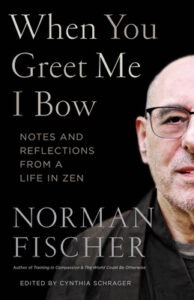
When You Greet Me I Bow: Notes and Reflections from a Life in Zen
Norman Fischer
Shambhala, 2021
Paperback: 336 pages
This is a treasure trove of essays written by Norman that cover his many decades of practicing Zen. The book is organized into four sections: Relationships, Emptiness, Culture and Engagement. It is a wonderfully touching collection born out of his dedication to both Zen and writing. In reading it, I felt met, welcomed and offered a seed of clarity on what a life of practice could be. Whether you are a recent graduate stepping into what a life of vocation could be, a long time practitioner or curious, I invite you to pick up this book and hear from Norman.
—Adam Klein
News & Updates
Yay, Margaret’s here!
Margaret Cowan McGrath joined the NVW staff in January as Graduate Community Steward. She’ll be coordinating graduate programs, guiding coaches in the recertification process, building connections among our global community, and lots more.
Margaret is a recent graduate of the Professional Coaching Course —the first cohort, in fact, that was both launched and completed during the pandemic. Her journey to the PCC originated from an abiding interest in people’s patterns and motivations: something that contributed to her successful years-long career as a romance novelist (the genre had been the topic of her graduate school thesis). The unexpected loss of her mom in 2015 set her on a new path: moved by the professionals who supported her family in the wake of their painful loss, and after some time in therapist training, she found Integral Coaching to be the answer to her longing to support others.
Now we get to be the lucky beneficiaries of her breadth of experience, depth of wisdom, agility, creativity, and what she calls her “mother hennish” desire to care for this community who has a very specific set of shared experiences and view of life.
Margaret was born in Halifax, Nova Scotia, and grew up in the American Midwest. Her early career as an IT consultant brought her around the country. She lived in San Francisco and New York before settling in with her family in Omaha, Nebraska. She lives with her husband Mark, their college-bound son, Owen, and their dog Kate.
Hear from Margaret herself in the Graduate News section below. We’re so happy she’s here, and are excited for you to get to know her.
Updated COVID safety guidelines
In Spring 2022 we will begin offering some blended Professional Coaching Course cohorts, with two of the four sessions taking place in person in our San Francisco classroom or a nearby venue. All-virtual cohorts will still be offered regularly.
The decision to hold blended courses is based upon whether the in-person experience would be an equal or superior one to virtual. For example, if public health requirements were such that all participants are masked and sitting six feet apart from one another, Zoom would offer a more intimate and impactful experience and we would revert back to virtual.
As of this publication, our hope is that it will soon be safe to gather in person without these limiting restrictions; however, as we well know by now, this could change. Fingers crossed we are heading back toward a more sustained place of safe in-person contact. Click through to learn more about our COVID guidelines.
Graduate News
Letter from the Graduate Community Steward
Dear graduates,

I am honored to take on the role of Graduate Community Steward. The use of the word “steward” intrigued me, so as an English nerd (and someone old enough to remember The Love Boat), I looked up the definition of steward:
one employed in a large household or estate to manage domestic concerns; an attendant on a ship, train or plane.
While the word is not one often heard in conversation, it conveys an elemental quality of our graduate community: it is a vibrant, living fellowship, one of the great strengths of New Ventures West, and worthy of the care and attention implied in the word steward. As a fairly recent graduate of the PCC (June 2021), taking on this stewardship role is an early manifestation of my ongoing work in the world, and I bring an open, curious heart, mind, and body to the possibilities around how I can support your work and development.
To that end, I encourage you to reach out to me at [email protected] so I can hear what’s making an impression on you. As New Ventures West graduates, we are fellow travelers on this particular journey through life, and I look forward to our conversations! I’ll bring the snacks to share.
Love,

Congratulations and welcome to our newest graduates!
Corinne Cayce, Afton, VA
Paula Collins, San Francisco, CA
Viviana Donikian, Alpharetta, GA
Robert DuBois, Santa Cruz, CA
Linda Favero, Lake Oswego, OR
Scott Flowers, Rockwall, TX
Patrick Fouché, Montclair, NJ
Nalani Genser, Boston, MA
Julian Giacomelli, Vancouver, BC
Andy Helgesen, Burlingame, CA
Danielle Kayal, Danbury, CT
Sha Liang, Novi, MI
Warren Liao, Glen Head, NY
MaryAnn Means-Dufrene, Fort Worth, TX
Ryan Prouty, League City, TX
Ghenno Senbetta, Chicago, IL
Theresa Sizemore, Eugene, OR
Sonia Vierra, San Bruno, CA
Sarah Watson, New York, NY
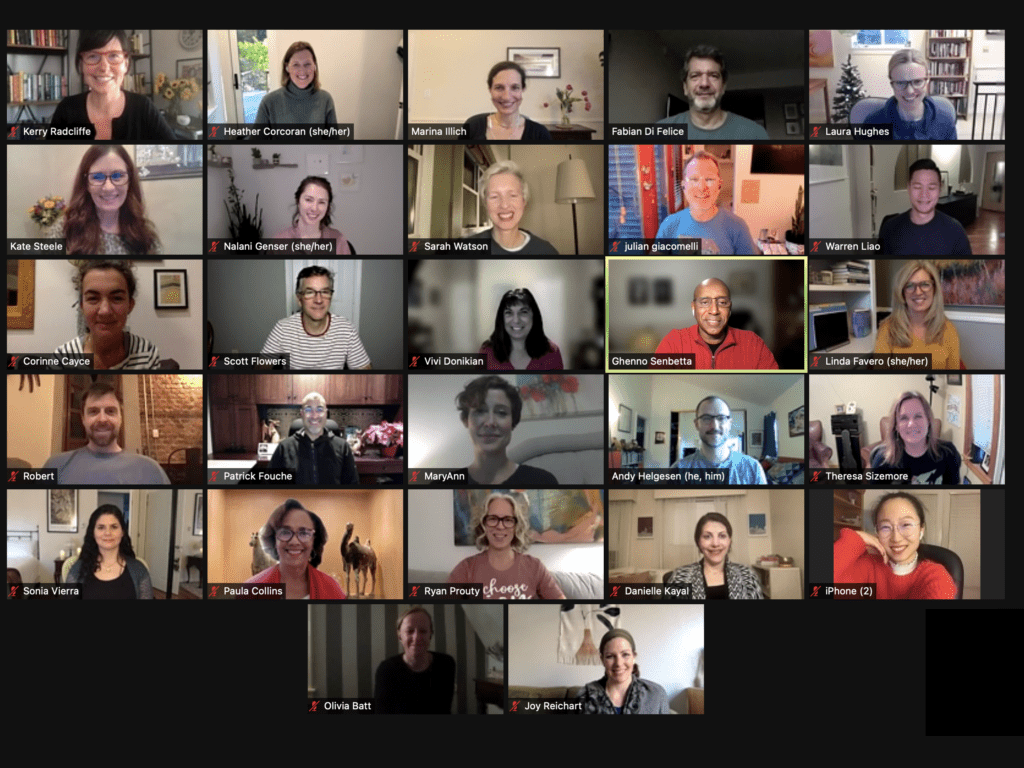
Here are the rock stars from PCC “B” on their graduation day in December. Welcome, new coaches!